
Harbor Stop 13: From Shame to Restoration

Today, we arrive at Harbor Stop 13: From Shame to Restoration
Today’s study is Part 4 of a 5-part series: The Journey Beyond Shame: A five-part journey from shame’s accusation to freedom in Christ.
The years behind you may hold regret, loss, or wounds you cannot change, but they do not have to determine the voyage ahead. God is still at work, and restoration begins when we place what remains into His hands.

🏠 Safe Harbor Awaits
There comes a point in the journey beyond shame when knowing we are forgiven must begin changing the way we live.
Shame keeps pulling our attention toward what is behind us. It reminds us of what we did, what was done to us, what we lost, and what we wish we could change. Even after we understand that our identity is found in Christ, shame can whisper that too much damage has been done and too many years have been lost.
But God does not free us from condemnation only to leave us standing in the wreckage.
Throughout Scripture, we encounter a God who restores. Restoration does not always mean returning everything to exactly the way it once was. Some consequences remain. Some relationships change. Some opportunities cannot be recovered. Some wounds leave scars. But scars are not chains.
Your past may always be part of your story, but in Christ, it does not have to determine the rest of your story. Perhaps you have spent years wishing you could sail backward and change something. You cannot relive yesterday, but your voyage is not over.
The storm may have left its marks upon the vessel, but the scars of the storm do not have to steer the ship.
There is still a course ahead.
⚓ Drop Anchor
Pause and Pray: Father, I give You the parts of my story I cannot change. Help me stop looking backward with condemnation and begin trusting You with what remains. Restore what You desire to restore, heal what needs healing, and teach me to believe that You are not finished with me. Amen.
🧭 Check Your Bearings
One of shame's most convincing lies is that continually punishing ourselves proves we are truly sorry. But repentance and self-condemnation are not the same thing.
Scripture says: “For godly sorrow produces repentance leading to salvation, not to be regretted…” ~ 2 Corinthians 7:10 (NKJV)
Godly conviction identifies what is wrong and calls us back to God. Shame identifies us by what went wrong and tells us to remain there.
– Conviction says, Bring this to Jesus.
– Shame says, Hide from Him.
– Conviction produces repentance and change.
– Shame produces condemnation and paralysis.
For those who belong to Christ, Scripture declares: “There is therefore now no condemnation to those who are in Christ Jesus…”~ Romans 8:1 (NKJV)
This does not mean our choices no longer have consequences. We may need to apologize, make restitution, rebuild trust, change our behavior, or accept consequences for something we have done. Taking responsibility is part of maturity. Living under condemnation is not.
There is also shame that never belonged to us in the first place. Sometimes another person's rejection, betrayal, abuse, abandonment, or cruelty leaves us carrying shame for something we did not cause.
Whether shame grew from something you did or something done to you, the question is the same: Are you allowing your past to tell you who you are, or are you allowing God to tell you who you are?
📖 Voices from the Harbor
There are seasons we wish we could recover. Years we would live differently if given another chance. Decisions we regret. Wounds we wish had never happened.
God does not ask us to pretend those things did not occur. Instead, He asks us to bring what remains into His hands.
“So I will restore to you the years that the swarming locust has eaten, the crawling locust, the consuming locust, and the chewing locust, My great army which I sent among you. You shall eat in plenty and be satisfied, and praise the name of the LORD your God, who has dealt wondrously with you; and My people shall never be put to shame. Then you shall know that I am in the midst of Israel: I am the LORD your God and there is no other. My people shall never be put to shame.” ~ Joel 2:25–27 (NKJV)
Joel spoke these words after Judah had experienced devastating loss. Locusts had stripped the land, crops had disappeared, and what once produced abundance had become barren.
But Joel's message was about more than damaged fields. In the midst of the devastation, God called His people back to Himself: “Now, therefore,” says the LORD, “Turn to Me with all your heart…” ~ Joel 2:12 (NKJV)
Before we hear, “I will restore,” we hear, “Turn to Me.”
Restoration began with returning to God.
This is important when we read God's promise to “restore…the years.” Joel 2:25 is not a guarantee that every lost relationship, opportunity, possession, or season will be returned exactly as it was. It reveals something deeper about the character of God.
Devastation is not beyond His restorative power.
And notice the words God repeats: “My people shall never be put to shame.”
Shame looks at what has been lost and says, There is nothing left.
God looks at what has been surrendered to Him and says, I am not finished.
We see this same truth in Peter. He had boldly promised that he would never deny Jesus. Yet when pressure came, he denied Him three times. Afterward, Peter went away and wept bitterly. He could not return to that courtyard and undo what he had done.
But after the resurrection, Jesus met Peter beside the Sea of Galilee. Three times Jesus asked, “Do you love Me?” and then entrusted Peter with the care of His people.
John 21:15-17. Jesus did not pretend Peter's failure never happened. He restored him.
Peter's failure remained part of his testimony, but it did not become the definition of his future. The man who denied Jesus would later stand before crowds and boldly proclaim the Christ he once denied knowing. Peter could not change what happened in the courtyard, but Jesus could change what happened next.
Nicky Cruz offers another powerful picture of what God can do with a life that seems headed toward destruction. As a young man, Cruz came to New York City carrying deep wounds from his childhood. He became involved in gang life and eventually rose to leadership in the Mau Maus, a violent street gang. Anger, violence, and rejection had become woven into the way he lived and the way he saw himself.
Then a young preacher named David Wilkerson entered his life with a message Cruz was not expecting. Jesus loved him. Cruz initially responded with anger and resistance, but Wilkerson continued pointing him toward Christ. Eventually, Cruz surrendered his life to Jesus.
His past did not disappear. The violence had happened. The wounds were real. The choices he had made were real. But they no longer had the authority to determine where his life would go.
The young man once known for violence eventually became an evangelist, spending decades telling others about the transforming love of Jesus Christ. Cruz's story reminds us that restoration is not God pretending our past never happened.
It is God giving us a new direction when our old course seemed to have determined our destination.
Peter could not change what happened in the courtyard. Nicky Cruz could not rewrite the years behind him. You cannot rewrite your yesterday either.
But you can surrender it to the One who already holds tomorrow.
This brings us back to the promise spoken through Joel: “So I will restore to you the years that the swarming locust has eaten…” ~ Joel 2:25 (NKJV)
God did not tell His people that the devastation had never happened. The stripped fields were real. The lost harvests were real. The years of loss were real. Yet God looked across what had been devastated and spoke of restoration.
That is the hope we carry forward.
Restoration does not mean God gives us our old life back exactly as it was. Peter could not undo his denial. Nicky Cruz could not erase his years of violence. We cannot retrieve yesterday and rewrite the parts we regret. But the God who said, “I will restore,” is able to take what remains and bring forth something that shame never imagined possible.
There may be consequences we still have to face. There may be scars we carry for the remainder of the voyage. There may be things that can never be returned to what they once were. But loss does not mean God is finished.
Shame looks at the lost years and says, “Look at everything that is gone.”
God looks at a surrendered life and says, “Watch what I can do with what remains.”
Joel's promise ends by pointing beyond restored fields to something even greater:
“Then you shall know that I am in the midst of Israel: I am the LORD your God and there is no other. My people shall never be put to shame.” ~ Joel 2:27 (NKJV)
The greatest evidence of restoration was not simply that the fields would produce again.
God was in their midst.
And perhaps that is the deepest truth of restoration for us as well. We may never recover everything shame tells us we lost, but in Christ, we discover something greater than recovering yesterday.
We discover that God is still with us, His grace is still at work, and our story is still in His hands.
⛵ Adjust Your Sails
Restoration invites us to move forward. There may be things you need to confess. There may be an apology you need to make or behavior that needs to change. There may be consequences you need to accept without allowing those consequences to become your identity.
There may also be things you simply cannot repair. That is often where shame tries to keep us trapped. It tells us that unless everything can be made exactly as it was, restoration is impossible.
But sometimes restoration looks different from returning. Sometimes it means allowing God to create something new where something old cannot be recovered. Scripture says: “Therefore, if anyone is in Christ, he is a new creation…” ~ 2 Corinthians 5:17 (NKJV)
You can:
– Acknowledge your past without living there.
– Remember what happened without allowing it to steer you.
– Learn from failure without wearing failure as your name.
– Carry scars without allowing them to become chains.
🌅 Harbor Reflections
There is something beautiful about a vessel that has survived a storm. It may carry evidence of waters it never intended to sail through. There may be repaired places and scars from where the waves struck hardest.
But those scars tell only part of the story. They also say the vessel survived.
Perhaps there are years of your life you wish you could recover. Or perhaps your life was altered by circumstances you never chose.
God does not ask you to call painful things good. He does not ask you to pretend devastation did not hurt. He asks you to trust Him with what remains. “And we know that all things work together for good to those who love God, to those who are the called according to His purpose.” ~Romans 8:28 (NKJV)
The scars may remain, but restoration does not erase the voyage behind you. It prepares you for the voyage still ahead.
🧹 Maintain the Deck
Shame often leaves things behind that need to be cleared away. Old labels. Old accusations. Mistakes we continually replay. Words spoken over us that we eventually began believing.
Spend a few quiet moments asking God to search your heart.
– What am I still holding against myself?
“As far as the east is from the west, so far has He removed our transgressions from us.” ~Psalm 103:12 (NKJV)
– What old label do I still answer to?
“Therefore, if anyone is in Christ, he is a new creation; old things have passed away; behold, all things have become new.” ~2 Corinthians 5:17 (NKJV)
– Am I confusing consequences with condemnation?
“There is therefore now no condemnation to those who are in Christ Jesus…” ~Romans 8:1 (NKJV)
– Am I carrying shame for something someone else did to me?
“They looked to Him and were radiant, and their faces were not ashamed.”~Psalm 34:5 (NKJV)
– What part of my story have I decided God cannot redeem?
“So I will restore to you the years that the swarming locust has eaten…”Joel 2:25 (NKJV)
Then bring each answer back to God's Word. Feelings change. Memories accuse. People may remind you of who you once were.
But the Compass remains true. Never navigate by the waves.
🙏 Cast Your Cares
Father, You know every part of my story. You know the decisions I regret, the wounds I carry, the years I wish I could recover, and the things I cannot change.
Where I have sinned, forgive me and help me walk in true repentance. Where I have been wounded, bring healing. Where shame has distorted the way I see myself, replace its accusations with Your truth. Jesus, I cannot change what is behind me, but I can surrender it to You. Help me repair what can be repaired, release what cannot be changed, and trust You with what comes next.bTeach me to leave condemnation behind and walk in the freedom You have given me. In Jesus' name, Amen.
🗺️ Plot Your Course
Before leaving this Harbor Stop, identify one place where shame is still influencing the way you live today.
Then ask yourself: If I truly believed what God says about me, what would one step toward restoration look like?
– Perhaps it is confession.
– Perhaps it is making something right.
– Perhaps it is forgiving someone.
– Perhaps it is asking for help.
– Perhaps it is accepting that something cannot return to what it once was.
– Perhaps it is finally refusing to call yourself by an old name.
You do not need to see the entire voyage, just take that simple step of faith towards God.
Check the Compass. Allow the Holy Spirit to guide the Rudder. Keep your eyes on Jesus, our Lighthouse. Then take the next faithful step.
🛟 Your First Step Home
True restoration begins with Jesus. If you have never surrendered your life to Him, you do not have to repair your past or make yourself worthy before you come. Jesus invites you to come as you are, turn from your sin, and place your faith in Him. If you are ready to begin a new life in Christ, you can pray:
Lord Jesus,
I know that I am a sinner and I need You. I believe You are the Son of God, that You died on the cross for my sins, and that You rose again. I turn from my sin and place my faith in You. Please forgive me, make me new, and be Lord of my life. I surrender my past, my present, and my future to You. Help me to follow You from this day forward. Thank You for loving me, forgiving me, and welcoming me home.
In Jesus’ name, Amen.
On the Horizon…
Our next Harbor Stop brings us to the 5th and final part of The Journey Beyond Shame: A Five-Part Journey from Shame’s Accusation to Freedom in Christ.
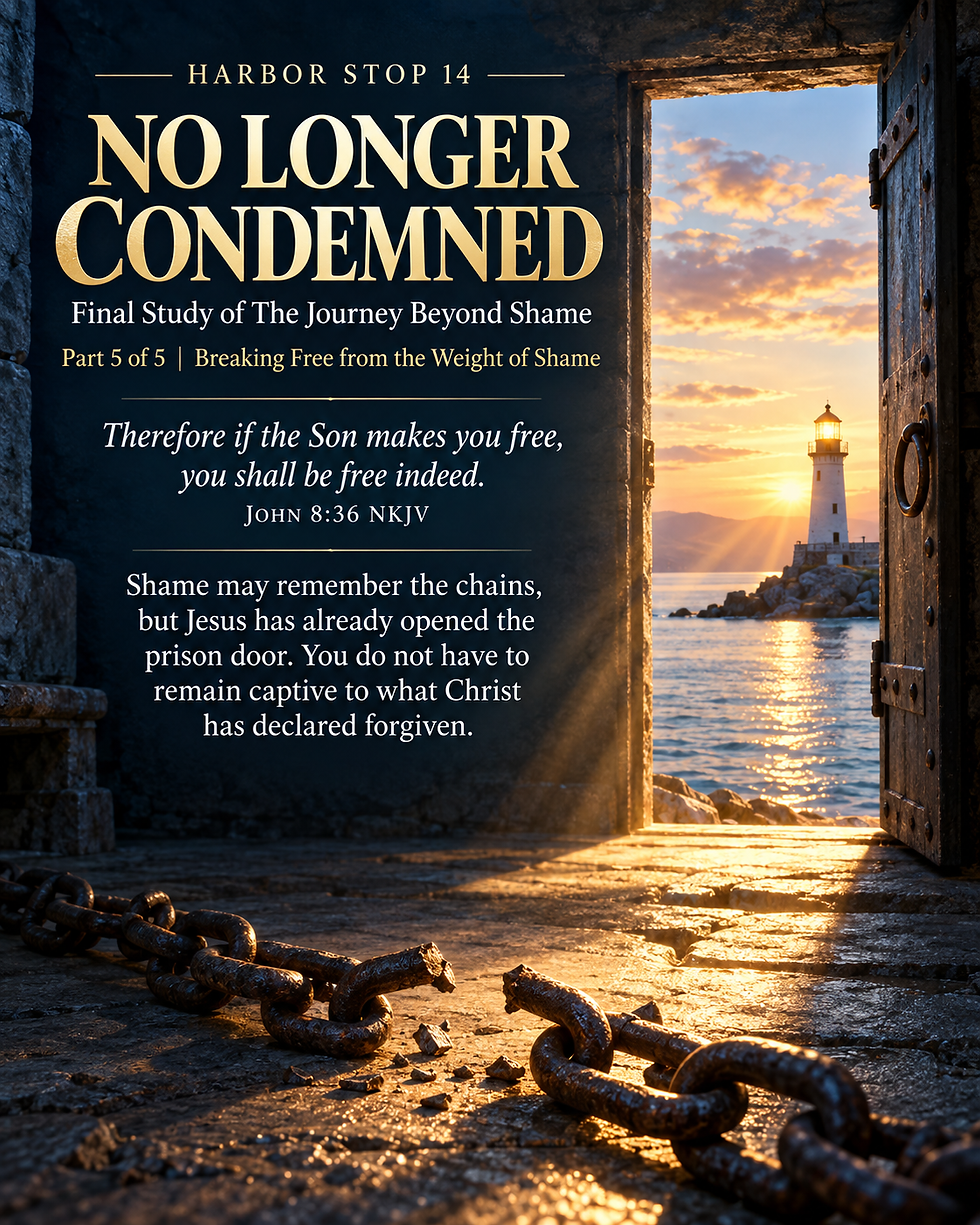
Harbor Stop 14: No Longer Condemned - We have faced shame’s accusations, confronted the identities it tried to give us, and discovered the restoring grace of God. At our final stop, we will anchor ourselves in the truth that brings this journey home:
In Christ, shame no longer gets the final word.
Until Our Next Harbor Stop…
──────────── ⚓ ────────────
The harbor is always open.


Comments